
When Reality Splits: Why Constitutional Literacy Is a Civic Survival Skill

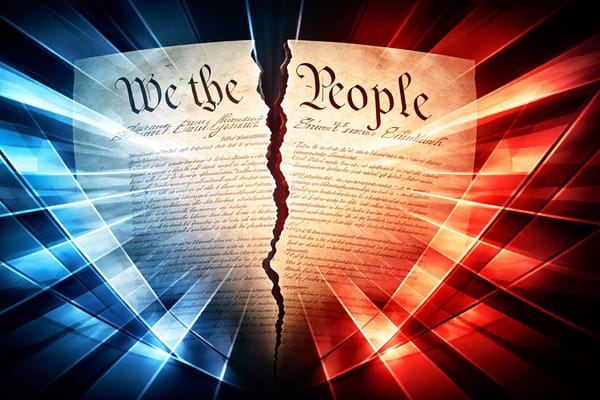
Why misunderstanding federalism fuels America’s constitutional arguments.
The Problem Is Not Disagreement. It Is Reality.
In today’s America, nearly every major policy debate ends with someone declaring, “That’s unconstitutional.”
- Immigration enforcement.
- Gun laws.
- Public health mandates.
- Environmental regulation.
Both sides cite the Constitution. Both claim precedent. Both dismiss the other as ignorant or dangerous.
This is not ordinary political disagreement. It is a fracture in shared methods for deciding what is true.
Democracies can survive conflict. They cannot survive the loss of shared rules for determining reality.
Democracies require shared procedures for resolving disputes. When those procedures weaken, every disagreement becomes existential.
Truth Requires Process
In The Constitution of Knowledge, Jonathan Rauch argues that truth in a free society is not owned by individuals. It is produced by institutions.
Courts test claims through adversarial procedure.
Science tests claims through peer review.
Journalism tests claims through verification standards.
Two rules anchor that system:
- No one gets the final say.
- No one wins by authority alone.
Claims must be checkable. Authority must be earned through evidence.
The system is imperfect. It is slow. It frustrates those who want immediate clarity.
It is also the only alternative to power determining truth.
Fragmentation Is Measurable
The erosion of shared factual ground is not anecdotal.
Research from Pew Research Center shows widening partisan gaps not just in policy preferences, but in basic factual beliefs about elections, immigration, crime, and public health.
A 2018 study published in Science by researchers at Massachusetts Institute of Technology found that false information spreads significantly faster than accurate information on social media platforms. Not because bots dominate, but because humans amplify novelty and emotional intensity.
Digital platforms optimize engagement. Engagement rewards outrage. Outrage erodes nuance.
The result is epistemic silos.
Federalism: The Structural Reality Behind the Noise
To understand how constitutional confusion spreads, consider federal immigration enforcement in cities like Minneapolis.
The Tenth Amendment states:
“The powers not delegated to the United States by the Constitution, nor prohibited by it to the States, are reserved to the States respectively, or to the people.”
That text is factual. It exists. The debate begins when interpretation begins.
Article I, Section 8 gives Congress authority to “establish a uniform Rule of Naturalization.” The Supreme Court has repeatedly held that immigration policy is primarily a federal responsibility. In Arizona v. United States, the Court struck down major portions of Arizona’s state immigration enforcement law, reaffirming federal supremacy in that domain.
So when federal agents enforce immigration law, that is not automatically unconstitutional.
But constitutional structure does not stop there.
In New York v. United States, Justice Sandra Day O’Connor articulated what became known as the anti-commandeering doctrine. Congress may not compel states to administer federal regulatory programs. She warned that presenting states with coercive choices is “no choice at all.”
That principle was reinforced in Printz v. United States, where the Court held that Congress cannot require state officers to execute federal law.
Two things can therefore be true at the same time:
- The federal government has authority over immigration enforcement.
- States cannot be forced to use their own personnel to carry it out.
Federalism is not a contradiction. It is a deliberate tension built to prevent consolidation of power.
The Constitution divides sovereignty on purpose. The friction is intentional.
Where Public Debate Collapses
Much of today’s constitutional rhetoric ignores these distinctions.
On the right, some argue sanctuary policies are unconstitutional because they obstruct federal law. That overstates federal power under anti-commandeering doctrine.
On the left, some argue federal enforcement actions in sanctuary jurisdictions violate the Tenth Amendment. That overstates limits on federal authority.
Both positions collapse three separate questions into one:
- What power is constitutionally delegated?
- Who may exercise it?
- What policy outcome do we prefer?
When those questions blur, constitutional language becomes a rhetorical weapon rather than a legal framework.
Civic Education Is Weak
This erosion of precision is not surprising.
According to the 2022 NAEP civics assessment, only 22 percent of eighth-grade students performed at or above the Proficient level in civics.
When structural literacy declines, constitutional language becomes symbolic rather than doctrinal.
“States’ rights” becomes a slogan.
“Federal supremacy” becomes a threat.
Neither is meaningful without context.
The Stakes: Procedure or Power
Democracy does not require agreement. It requires shared procedures for resolving disagreement.
If courts are legitimate only when they rule in our favor, the rule of law collapses into tribal loyalty.
If constitutional interpretation becomes partisan branding, federalism becomes theater.
If every enforcement action is labeled tyranny and every disagreement becomes existential, compromise becomes impossible.
Jonathan Rauch reminds us that knowledge institutions are fragile. They function only when citizens accept common standards of verification and correction.
Without those standards, the loudest voice or the most powerful actor determines reality.
History suggests that republics do not thrive under those conditions.
Rebuilding Constitutional Literacy
Constitutional literacy is not a hobby for law students. It is a civic responsibility.
- Read primary sources.
- Distinguish authority from preference.
- Separate what government can do from what it should do.
- Admit uncertainty when doctrine is unsettled.
- Most importantly, resist weaponizing the Constitution for rhetorical advantage.
The document is not a banner for tribal identity. It is a structural restraint designed to limit power at every level.
If we want fewer reality splits, we need fewer instant conclusions and more institutional humility.
That work will not trend. It will not go viral.
It is also the difference between a country that argues and a country that fractures.
DISCLAIMER: I'm not a lawyer, civics expert or educator. These are my opinions.
Sources & Further Reading
Constitutional Text
U.S. Constitution, Tenth Amendment
https://constitution.congress.gov/constitution/amendment-10/
U.S. Constitution, Article I, Section 8
https://constitution.congress.gov/browse/article-1/section-8/
Supreme Court Decisions
McCulloch v. Maryland, 17 U.S. 316 (1819)
https://www.law.cornell.edu/supremecourt/text/17/316
New York v. United States, 505 U.S. 144 (1992)
https://www.law.cornell.edu/supremecourt/text/505/144
Printz v. United States, 521 U.S. 898 (1997)
https://www.law.cornell.edu/supremecourt/text/521/898
Arizona v. United States, 567 U.S. 387 (2012)
https://www.law.cornell.edu/supremecourt/text/11-182
National Federation of Independent Business v. Sebelius, 567 U.S. 519 (2012)
https://www.law.cornell.edu/supremecourt/text/11-393
Constitutional Doctrine & Analysis
Library of Congress, Constitution Annotated: Tenth Amendment and Anti-Commandeering
https://constitution.congress.gov/browse/essay/amdt10-4-2/ALDE_00013627/
Rauch, Jonathan. The Constitution of Knowledge: A Defense of Truth. Brookings Institution Press, 2021.
https://www.brookings.edu/books/the-constitution-of-knowledge/
Research on Information Fragmentation
Pew Research Center. Political Polarization and Public Trust Research
https://www.pewresearch.org/topic/politics-policy/political-polarization/
Vosoughi, Soroush; Roy, Deb; Aral, Sinan. “The Spread of True and False News Online.” Science (2018).
https://www.science.org/doi/10.1126/science.aap9559
MIT News Summary of Study
https://news.mit.edu/2018/study-twitter-false-news-travels-faster-true-stories-0308
Civic Education Data
National Assessment of Educational Progress (NAEP), Civics Results 2022
https://www.nationsreportcard.gov/civics/results/achievement/